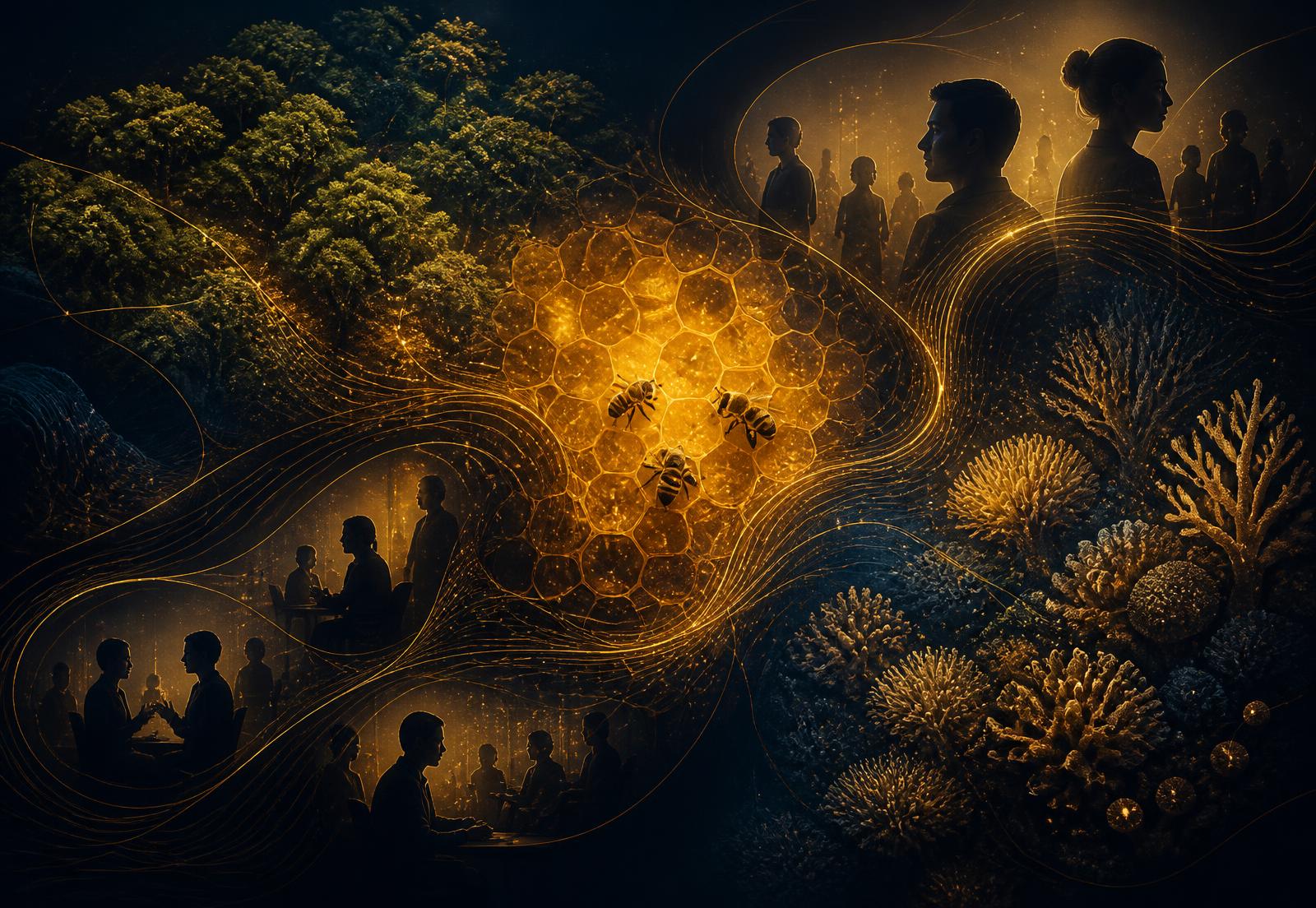
Living systems in nature, like forests, coral reefs, and the human body, are made up of interconnected parts that depend on one another to survive, adapt, and grow. A forest relies on the exchange between soil, roots, fungi, insects, animals, water, and sunlight. A coral reef depends on balance among many species and is vulnerable when one part of that balance is disrupted. The human body similarly depends on systems that communicate continuously: when one system is under strain, others respond.
A beehive is a powerful example of a living system. Although each bee has a distinct role, the hive's health depends on coordination, communication, shared resources, and the ability to adjust to changing conditions. No bee operates completely alone; each action contributes to the stability, productivity, and survival of the colony. The Hive offers a useful model for understanding a modern workforce in the same way.
"A modern workforce must operate more like a living Hive than a static organizational chart."
Workforce as ecosystem, not collection
Like a natural hive, a workforce is not a collection of isolated individuals. Each person has a role, perspective, skill set, and need that affects the larger system. Communication functions like a circulatory system: information, feedback, trust, and support must move freely for the group to make sound decisions. When communication is delayed or blocked, the whole system can become disconnected from what its people need.
Where traditional systems fall behind
Business ecosystems have struggled to modernize alongside an ever-evolving workforce. Many traditional systems were built around slower change, fixed roles, top-down decision-making, and delayed feedback. However, the modern workforce expects greater flexibility, inclusion, purpose, development, and responsiveness. Because workplace conditions now shift quickly, systems that do not operate in real time often create a gap between organizational decisions and employees' lived experiences.
Listening before problems become entrenched
A modern workforce must operate more like a living Hive than a static organizational chart. It must continuously listen, recognize emerging patterns, connect people to the support they need, and respond before challenges become entrenched. Rather than waiting for annual surveys, performance cycles, or a crisis to reveal problems, organizations need an ongoing awareness of the health of their workforce.
Interdependence, not isolation
The Hive comparison also highlights interdependence. Individual wellbeing, team trust, leadership behavior, communication practices, and organizational policies all influence one another. A modern workforce should not treat stress, disengagement, conflict, or turnover as isolated events. They may instead be signals that relationships or conditions elsewhere in the ecosystem need attention.
Building workplaces that evolve with people
Ultimately, the future of work is not about making people fit outdated systems. It is about building workplaces that can evolve with people, just as a living system evolves in response to changes in its environment. A healthy Hive is adaptive, connected, and aware of the needs of its members. In the same way, a healthy modern workforce must be responsive, human-centered, and capable of learning in real time.
Want to keep the conversation going?
Connect with Maranda on LinkedIn and share what this sparked for you.

Maranda Jean
Co-Founder, Chief People Officer & Director, HiveSTRONG
Maranda leads people strategy for Hive Enterprises and directs HiveSTRONG. Her work focuses on people systems, organizational culture, dignity, stability, and survivor centered infrastructure for employers and community partners.
Follow Maranda on LinkedIn